

Quick answer: An armored fidget spinner is a spinner with outer sections that change position while the body rotates. In a deployable design, rotation remains the primary interaction, while linked parts add a second layer of mechanical movement and visible shape change.
The result looks more complex than a conventional fixed-frame spinner, but the basic idea is easy to follow: finger input starts the rotation, the rotating assembly carries the outer structure, and the linkage controls how those sections move. This guide explains the system without treating every armored spinner as mechanically identical.
What Is an Armored Fidget Spinner?
An armored fidget spinner is a handheld spinner whose outer geometry can open, shift or deploy during use. “Armor” describes the visual form of the moving outer sections; it does not mean the spinner is protective equipment.
The spinner is still defined by rotation. The deployable sections are a secondary mechanical system that changes the silhouette and adds visual, audible and tactile feedback. This makes the design a useful example of how one EDC fidget can combine a familiar form with a more complex motion-transfer system.
| Feature | What It Does |
|---|---|
| Central rotation | Creates the primary spinner interaction |
| Linked outer sections | Move through a constrained path instead of remaining fixed |
| Changing mass distribution | Alters the silhouette and the way motion looks and feels |
| Mechanical and airflow sound | Adds audible feedback as speed increases |
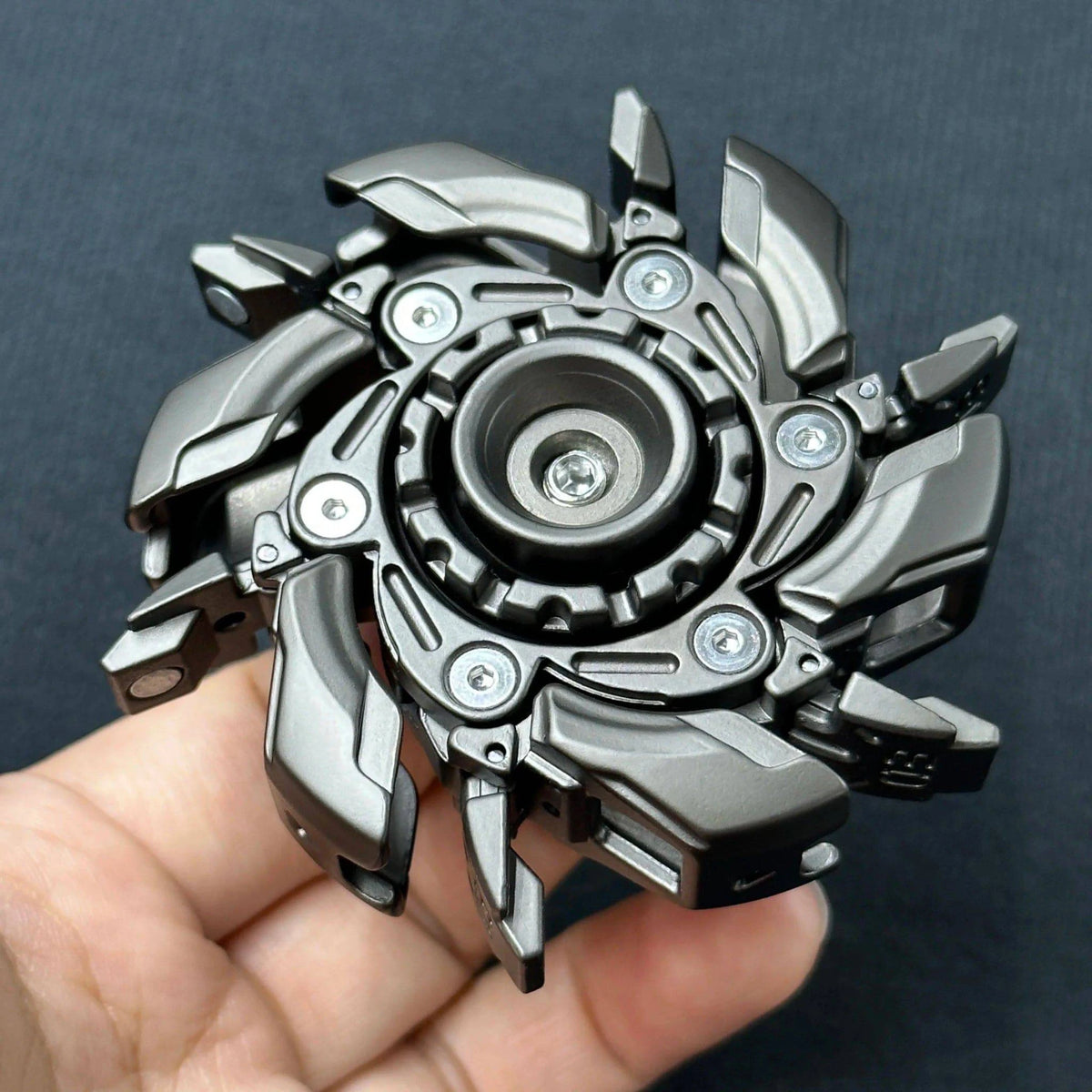
How Do Deployable Fidget Spinners Work?
A deployable spinner combines rotational support with a structure that transfers or redirects movement. The exact internal layout varies by product, so the safest way to understand one is to separate the system into four stages.
- Input: Your finger starts the spinner around its central axis.
- Rotation: The bearing or rotational assembly supports the main spinning motion.
- Motion transfer: Links, pivots, tracks or related geometry constrain how the outer sections can move.
- Feedback: The moving structure changes the silhouette and can add vibration, airflow and mechanical sound.
In the RageBurst 08 Deployable Armor Fidget Spinner, the confirmed product design uses linked outer armor sections that shift while the spinner rotates. The product is best described as a spinner with a linked deployable-armor system—not as a completely different fidget category.
For the broader engineering vocabulary, see How Fidget Mechanisms Work. Its motion-transfer section explains how links, cams and pivots can convert one input into deployment, translation, rocking or other compound movement.
Deployable Spinner vs Traditional Spinner
| Characteristic | Traditional Spinner | Deployable Armored Spinner |
|---|---|---|
| Primary interaction | Continuous rotation | Continuous rotation |
| Outer frame | Usually fixed | Includes sections that change position |
| Visual feedback | Mostly the blur and motion of the body | Visible transformation as the outer geometry moves |
| Sound | Often dominated by the bearing and airflow | Can include linkage, mechanical movement and stronger airflow |
| Care | Focuses on the bearing and fixed body | Also includes links, pivots and moving fasteners |
Neither design is automatically better. A traditional spinner suits people who want simple, repeatable rotation. A deployable spinner is more appealing when visible mechanics, changing geometry and a more cinematic interaction matter.
Why Balance and Mass Distribution Matter
Every spinner depends on balance around its axis. When outer parts move, their mass changes position relative to the center. The design must manage that movement consistently or the spinner can feel uneven.
Several factors shape the experience:
- Symmetry: Matching sections should move through similar paths.
- Linkage geometry: The allowed path determines how the silhouette opens and closes.
- Joint friction: Too much resistance can make movement feel hesitant; too little control can increase play.
- Mass location: Weight farther from the axis can change rotational inertia and perceived stability.
- Bearing condition: Contamination, damage or poor seating can introduce drag and vibration even when the deployable structure is working correctly.
Read Fidget Spinners Explained for a deeper guide to bearings, balance, inertia and rotational geometry.
Materials, Sound and Airflow
Material affects mass, resonance, surface feel and durability, but it does not determine the experience on its own. Geometry, joint design, finish, bearing performance and tuning still matter.
RageBurst 08 is confirmed as a metal spinner, but TitanFidget does not infer a specific alloy where reliable product evidence is unavailable. Its product page describes moderate sound produced by mechanical movement and airflow. That makes it better suited to users who enjoy audible feedback than to silent meeting use.
For a practical explanation of density, mass distribution, finish and working surfaces, continue to How Fidget Materials Change the Experience.
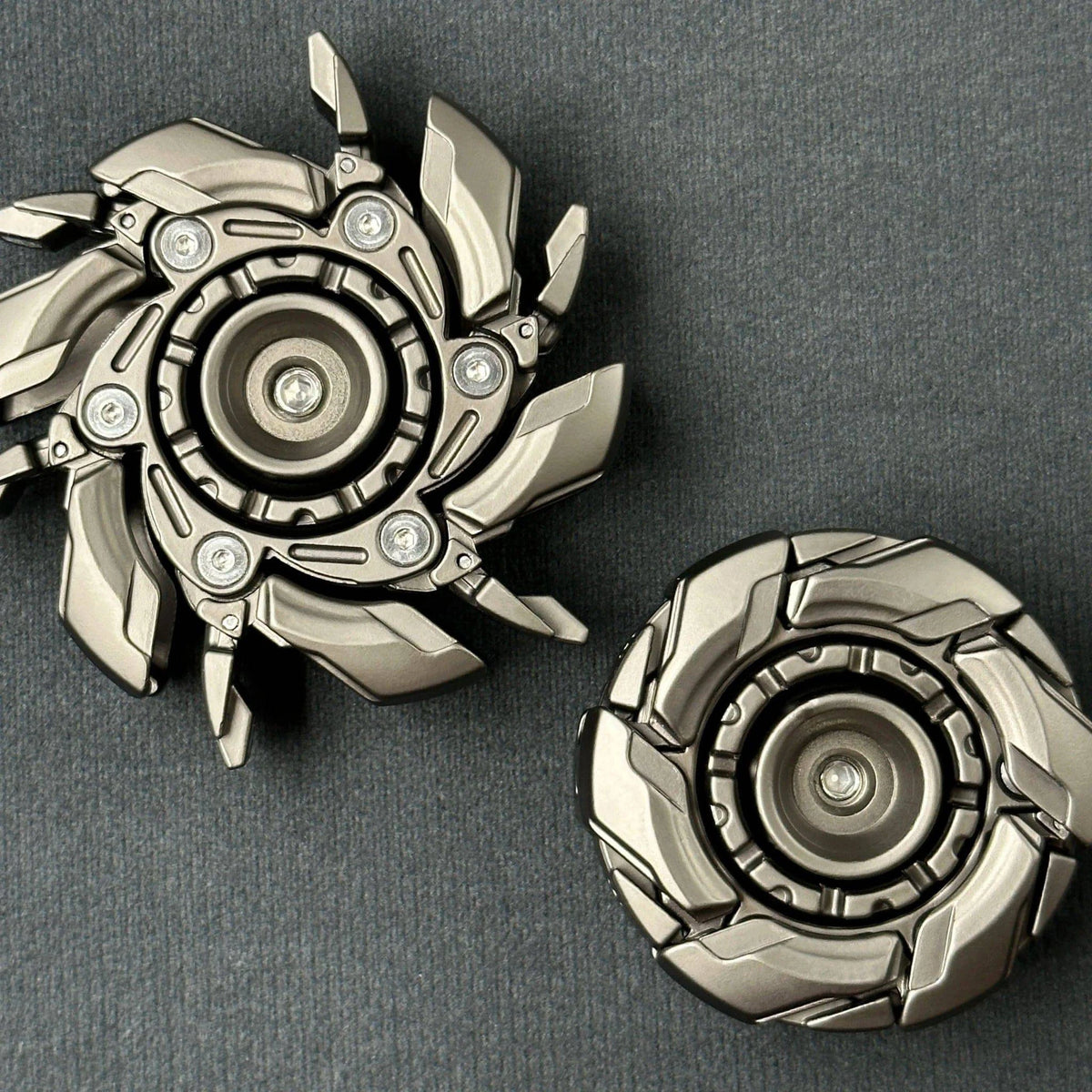
RageBurst 08 as a Real-World Example
RageBurst 08 starts with the familiar interaction of a spinner, then adds linked outer sections that shift during rotation. The design is built around three kinds of feedback:
- Rotational feedback from the central spinning motion.
- Visual feedback as the outer geometry changes position.
- Audible feedback from the moving linkage and airflow.
That combination makes it a multi-mode experience without changing its primary form: it remains a fidget spinner. If you want to compare it with other rotational and mechanical designs, browse the Fidget Spinner collection.
See the RageBurst 08 Deployable Armor Fidget Spinner →
Safe Use and Basic Care
A shape-changing spinner needs more clearance than a compact fixed-frame design. Use it over a clear surface and keep fingers, loose fabric, hair and nearby objects away from the moving outer sections.
- Do not force the deployable sections by hand if they resist movement.
- Avoid hard impacts and drops, especially while the armor is open.
- Keep the spinner dry and wipe it with a soft cloth.
- Check moving fasteners periodically and stop using the spinner if a section becomes loose.
- Test at moderate speed after cleaning or reassembly before using a stronger launch.
If the spinner slows down, feels rough or develops bearing noise, use the Fidget Spinner Won't Spin? troubleshooting guide before assuming the deployable system is the cause.
Common Questions
Does every armored fidget spinner deploy?
No. “Armored” can be used as a visual style name, while “deployable” should describe outer sections that actually change position. Check the product mechanism rather than relying on the name alone.
Is a deployable spinner a hybrid mechanism?
It can be described as a multi-system design when both rotation and the linked deployment meaningfully shape the interaction. However, “hybrid” should not be applied automatically just because a product contains several parts. Classification should follow what each system actually contributes.
Are deployable fidget spinners quiet?
Not necessarily. Moving links, pivots and outer sections can add mechanical sound, while the changing geometry can increase airflow noise. RageBurst 08 is rated as moderate rather than silent.
What should I check if the armor stops moving smoothly?
Stop the spinner and inspect for debris, uneven seating, loose fasteners or visible damage. Do not force a stuck section. If the main rotation is also rough, diagnose the bearing separately.
Continue in the TitanFidget Guide Hub
Use these resources to connect the design to the broader EDC fidget system:
- TitanFidget Guide Hub — the full map of fidget types, systems, materials and terminology.
- Fidget Spinners Explained — bearings, rotation, balance and inertia.
- How Fidget Mechanisms Work — force, motion support and motion-transfer systems.
- Fidget Materials — how mass, finish and geometry influence the experience.
- Spinner Troubleshooting — practical checks for drag, noise, wobble and bearing problems.
Armored spinners are compelling because the mechanism is visible: the object does not only rotate—it changes form while it moves. That makes the deployable system part of the experience, not decoration added after the fact.
